Research Summary
The research focus of Fauth-lab is computational neuroscience, with an emphasis on understanding how computation, learning and memory arise from the physical and self-organizing properties of neurons and neural networks. Our work bridges multiple scales, from the molecular dynamics within a single synapse to the emergent properties of large networks and their technological applications.
The lab's research is organized around three main themes :
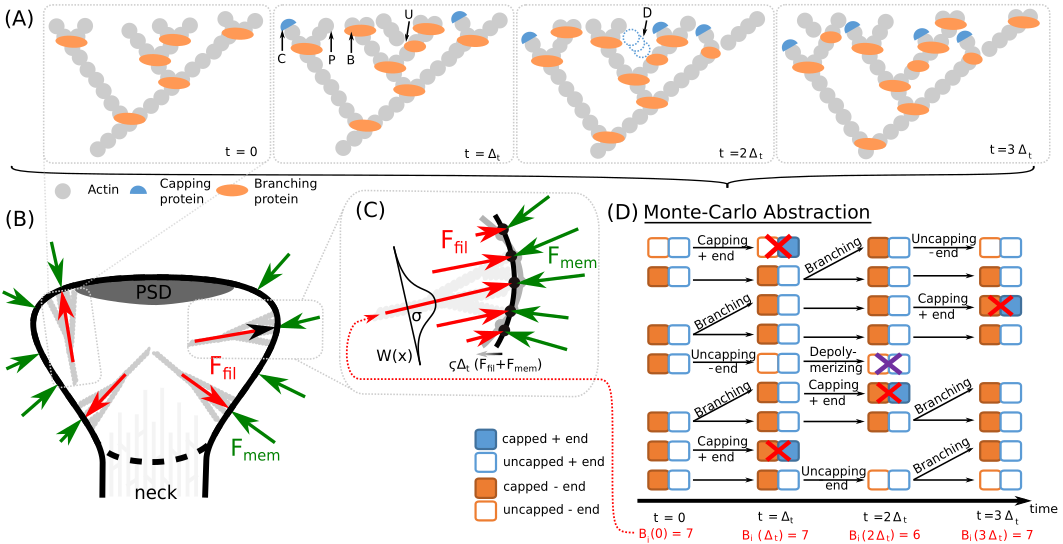
1. The Biophysical Basis of Synaptic Plasticity
We investigate the fundamental physical mechanisms within a dendritic spine that allow it to change and store information. A central hypothesis is that the "synaptic tag," a temporary marker that designates a synapse for long-term memory, is not a single molecule but an emergent physical state of the spine itself. This work proposes that the reorganization of the actin cytoskeleton—the protein network that gives a spine its shape—serves as this physical memory trace.
Key Publications:
- Models of actin dynamics are used to explain the characteristic shape of dendritic spines (Bonilla-Quintana, 2019) and how they can achieve a state of self-organized criticality, keeping them poised to respond to plasticity-inducing stimuli (Bonilla-Quintana, 2021).
- The synaptic tag is proposed as an emergent biophysical state arising from the interaction between the actin network and the postsynaptic density (Negri and Luboeinski, 2026).
- Experimental and modeling work shows that changes to actin dynamics and spine geometry induced by long-term potentiation (LTP) persist on the same timescale as the synaptic tag (Thomas, 2025).
- Further modeling show that these geometry changes can be consolidated into changes of the postsynaptic density, assuming that latter grows through capturing plasticity-related proteins and this growth can be gated by the local membrane shape.(Thomas, 2026).
2. Memory Stability, Consolidation, and Self-Organization
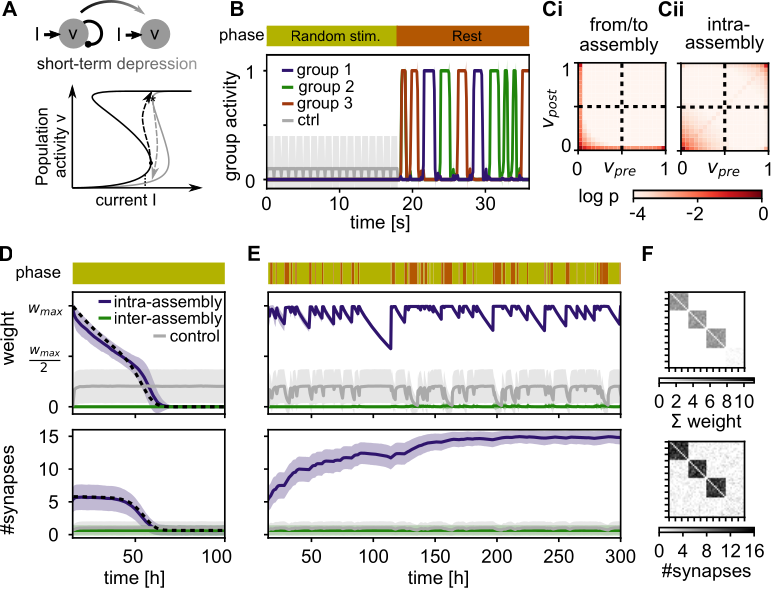
We are interested in the classic dilemma of how memories can remain stable for years when the synapses that store them are themselves transient, with high rates of turnover. The research explores how self-organizing principles and systems-level consolidation processes can create robust long-term storage from unreliable components, but also aims to integrate findings from the biophysical level.
Key Publications:
- The roles of different types of neural activity, such as spontaneous and evoked ripples, are investigated in the context of memory consolidation, particularly in neurons with active dendrites (Jauch, 2024).
- Self-organized reactivation of neural ensembles, similar to what occurs during sleep, is shown to be a mechanism that can maintain and reinforce memories against synaptic turnover (Fauth, 2019).
- Neuronal activity can both stabilize and destabilize synaptic structures, suggesting Hebbian as well as homeostatic effects (Fauth, 2016).
- Long-term information storage emerges already between a pair of neurons despite high rates of synaptic turnover (Fauth, 2015).
- Recurrent neural networks can self-organize their structure to create reliable pathways for information transmission through multiple network layers (Miner, 2021).
- A large review on the multi-scale nature of structural plasticity and its translational persectives (Fauth, 2026)
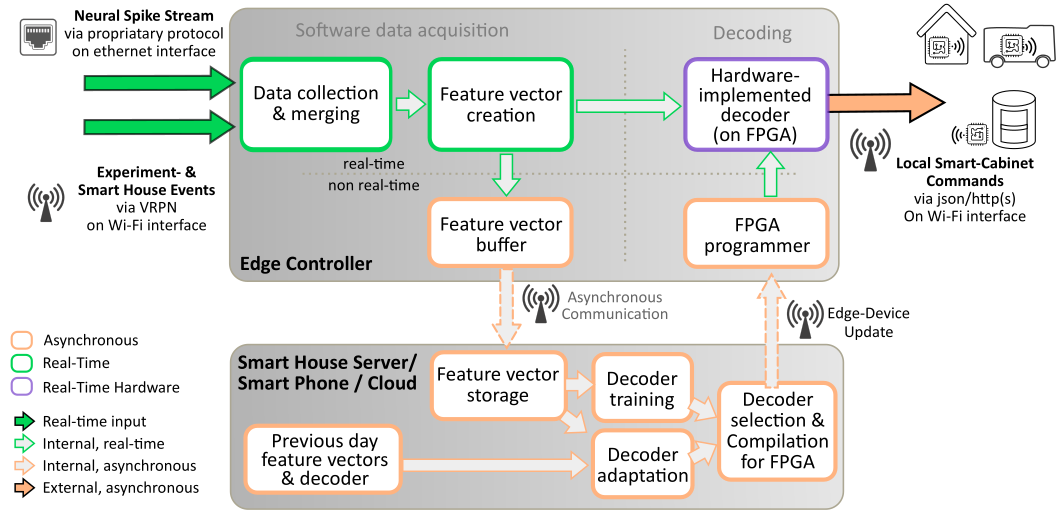
3. Application of Self-Stabilization Principles to Brain-Machine Interfaces (BMIs)
This work is a first stept to transfer neuroscientific findings into practical, real-world technology. By understanding and decoding the neural signals related to planning and intention, this research aims to create more intuitive and proactive interfaces between the brain and external devices.
Key Publications:
- A BMI framework based on low-dimensional manifolds can decode intended actions allowing for proactive control of a smart home environment (Braun and Fauth, 2024).